
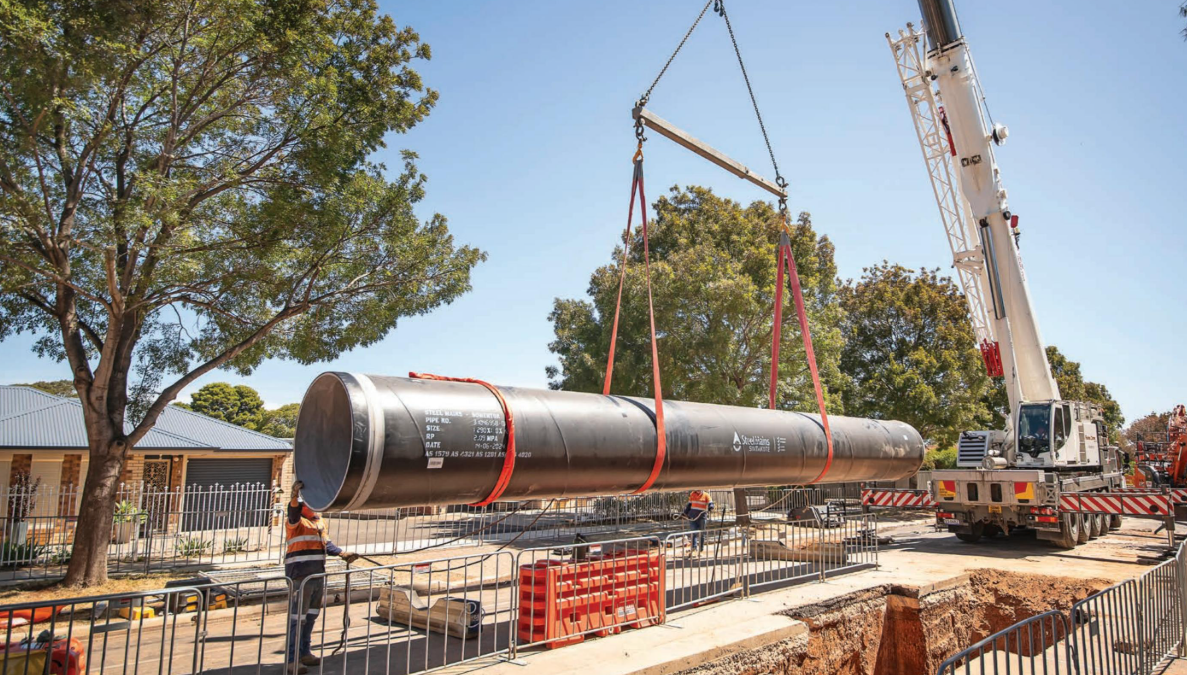
SA Water's largest metro network expansion in decades is well underway, and the utility has hit some key milestones that are laying the foundation for the state's thriving future.
Water utilities across Australia are grappling with rapid housing growth, infrastructure catch-up, and the need to support new developments
without compromising existing service standards.
Along with a significant upgrade at the utility's Bolivar Wastewater Treatment Plant, SA Water is laying the foundations to ensure South Australia's growing communities and future generations have access to reliable services.
The utility has laid more than 25,000m of new water and sewer pipes across Adelaide's northern suburbs in just 12 months, marking a major milestone in the fast-tracked delivery of critical infrastructure needed to unlock housing in key growth areas.
SA Water General Manager of Growth Amanda Lewry said the utility is standing at a critical inflection point.
"This is not just about laying pipe, but about building the backbone of essential service systems to meet our state's needs for the next 30 years with continued investment," she said.
"The entire industry is being tested, and I believe we are rising to the challenge. There is a renewed sense of purpose across water utilities right now. We understand that the housing crisis requires a shared solution, and it needs infrastructure and leadership. That is what we are seeking to deliver."
A shared challenge
In South Australia, this challenge is being tackled head-on as part of a $1.5 billion investment through the South Australian Government's Housing Roadmap, launched in June 2024.
In what is the largest metropolitan network expansion for SA Water in decades, the significant investment will enable an estimated 40,000 new homes to be built across the state over four years.
"We are not just responding to growth, we are now actively enabling it," Ms Lewry said.
This progress as of mid-October represents more than a quarter of the program's anticipated total length of pipe to be delivered, with between 20 to 30 construction crews currently active across Adelaide's north.
More than 100,000 hours of direct construction have been logged to achieve this, with installation spanning new water and sewer trunk mains, pump stations and other key assets.
The scale of work already completed is significant, with more than 13,000 metres of new trunk water mains installed to support new development areas including within Angle Vale and Riverlea.
In addition, 12,000m of sewer pipes have been installed across Munno Para and Roseworthy, along with supporting pump stations and trunk assets designed to duplicate and expand network capacity.
These areas are among the state's fastest growing, with large greenfield developments requiring backbone infrastructure to connect new areas into existing networks.
"We are seeing growth that would usually take a decade to happen, occurring in a matter of years," Ms Lewry said.
"To keep up, we have had to be bold and adapt our delivery models, compress timelines and move quickly from planning to implementation."
Upgrading Adelaide's poo powerhouse
In another significant milestone, SA Water is entering the final stages in the first of a series of upgrades
- totaling $121 million - at its Bolivar Wastewater Treatment Plant, with the facility's new inlet now operational and primed to serve Adelaide's expanding north.
Bolivar is the state's largest wastewater treatment facility, managing wastewater for the majority of metropolitan Adelaide.
The newly installed screens and upgraded inlet structure more than doubles the plant's daily processing capacity, rising from about 300ML to up to 630ML of raw sewage per day.
The inlet includes eight new screen trains, standing more than 6m high, which filter out items like wet wipes, paper and plastic before the flow of sewage goes further into the system.
The ten existing inlet pipes are also being replaced to support future anticipated flows as new greenfield developments in Adelaide's north connect to SA Water's sewer network, and two new pump stations now service the screens to reduce manual cleaning and improve safety and efficiency.
Future upgrades at Bolivar will involve optimising its activated sludge reactor process and upgrading the sludge management facility, further increasing the plant's treatment capacity and operational efficiency.
The $121 million investment comprises $64 million
million from its 2024-28 program. These upgrades form a central piece of SA Water's record $3.3 billion capital program and underpin its capacity to support Adelaide's growing population.
"Upgrading Bolivar is a key step in unlocking wider capacity for housing growth and this work ensures the plant is being prepared for new and expanding communities," Ms Lewry said.
With early work now well progressed across key northern growth fronts, the next tranche of infrastructure delivery is already underway and is focused on unlocking more land, increasing capacity and reinforcing the backbone of the metropolitan water and wastewater network.
Among the most significant upcoming projects is one at Sandy Creek, where SA Water is constructing two new IOML water storage tanks, a new control valve building and an underground trunk main connecting the tanks to the existing Barossa network.
These projects will directly support maintaining services to our existing customers while providing the initial investments to support continued residential growth in the Concordia, Roseworthy and Gawler East.
At the same time, SA Water is preparing for new water infrastructure expansions west of Angle Vale, and in Adelaide's southern suburbs at Onkaparinga Heights where new land releases are driving the need for additional network capacity.
"The pace we are working at today is unprecedented, and necessary," Ms Lewry said.
"This is our once-in-a-generation opportunity and as an industry, we are stepping up."